.jpg)
Jewish Grief Rituals
טקסי אבל יהודי
However much we love, we will have that much grief. Loss is an inherent part of being human, yet we are rarely given real permission or space to feel it. Grief remains unspoken, unmetabolized, carried alone in bodies and hearts that were never meant to hold it that way.
A grief ritual offers a different way.
What Is a Grief Ritual?
A grief ritual is a communal container, a held, structured space, to honor and release what we carry: personal loss, family pain, ancestral wounds, collective sorrow. It is not therapy, and it is not a memorial. It is something older than both.
Our ancestors knew how to grieve together. They tore their garments, wailed, and fell to the earth. Women called mekonenot, professional mourners, led communities in lament. The Talmud teaches that while the gates of prayer may close, "the gates of tears are never locked" (Berachot 32b). Much of this wisdom has been forgotten. These rituals are one step in remembering it.
My own path into this work came through Malidoma Somé and the Dagara tradition of Burkina Faso, where communal grief ritual has been powerfully preserved. Encouraged by Malidoma to connect it with our own roots, I have been integrating this work with Jewish tradition here in Israel, weaving together song, movement, prayer, and the healing power of community.
Why Grieve Together?
There is a limit to what we can release alone, or even with one other person. To let grief take its natural course, we need a powerful container. The group holds something that cannot be held alone, a nervous system larger than our own, a gaze that welcomes the parts of us that have never been fully welcomed.
When we step into ritual together, we step into a different pace, a different listening. Pain that has been silenced finds a place to land. Sorrow that has been carried in isolation becomes shared, and in that sharing, something begins to move.
What Happens?
Over two to three days, we build a sacred space together in nature. Altars serve as focal points, spaces for grief, for resource, for gratitude. Through song, movement, guided sharing, and prayer, we create safety for the heart to feel and express what it carries. The ritual is held within a warm, boundaried community, where each person moves at their own pace and no one is required to share aloud.
Building that safety takes time, which is why we return to the ritual several times across the gathering, each round going a little deeper, the container growing stronger.
Who Is This For?
This ritual is for anyone who senses grief sitting in the body, as sadness, numbness, a quiet ache, or an overwhelm without a clear name. For those carrying personal heartbreak, family pain, generational wounds, or the collective sorrow of our current moment. For anyone who feels disconnected from themselves, from others, from spiritual ground, and is ready to not do this alone.
No prior experience with ritual, therapy, or group work is needed.
“Those who sow in tears will reap in joy.”
— Tehillim 126:5

Past Rituals
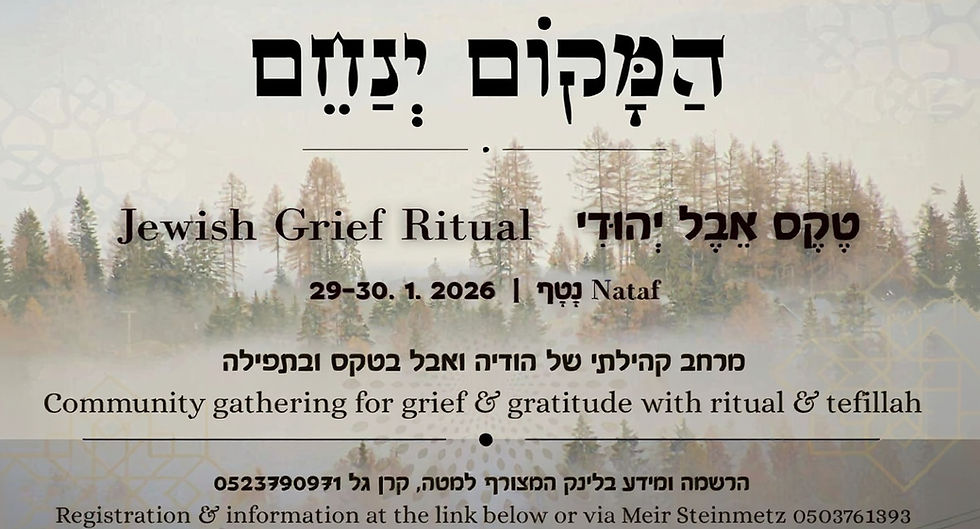
Shevat Grief Ritual
January 29–30, 2026 | Nataf
Join us in Nataf for a two-day Jewish grief ritual: a gentle, supportive space for expression, healing, and community. Through song, movement, sharing, nature, and Tefillah, we’ll experience the wisdom of David HaMelech:
הַזֹּרְעִ֥ים בְּדִמְעָ֗ה בְּרִנָּ֥ה יִקְצֹֽרו
Those who sow in tears will reap in joy
More details + registration in link
https://jewishgriefritual.lovable.app/

Testimonials from participants of past rituals
“I just wanted to let you know how grateful I was to you for the grief space you opened up. It really was what I was needing and helped me not feel so alone in it… I believe this practice should continue. To bring it into our communities to be able to talk about it more openly and offer support communal support”
Briah Cahana
Rabbi
“This is healing for people and for the world. Years of therapy cannot replace what community can give in processing pain and grief.”
Eliya P.
Retreat participant
“Having the safe environment to tap in with the supportive group and boundaries was more powerful than I had imagined and I feel blessed to have had the opportunity to join that. Thank you deeply”
Miriam
Retreat participant
“I feel lighter, released from a burden I was carrying, and maybe also with the beginning of tools to release more of it myself. The sense of community and moving through this process together was very powerful for me. And even though we probably won't meet again in exactly this configuration, there is a feeling that this continues to be my community. A sense of belonging, the possibility to bring myself in a clean, simple, unapologetic way, to move at my own pace. I feel privileged to receive this gift, and a desire to let everyone experience it. There is a softness I had been waiting for, and it was fully here.”
Chen B.
Retreat participant
“It was a connecting and balancing weekend. I was able to bring parts of myself that usually don't agree to come forward and give them healing space. There was a soft and pleasant connection with the drums and with the dance. The ritual allowed me a very powerful and liberating dance.”
Almog B.
Retreat participant